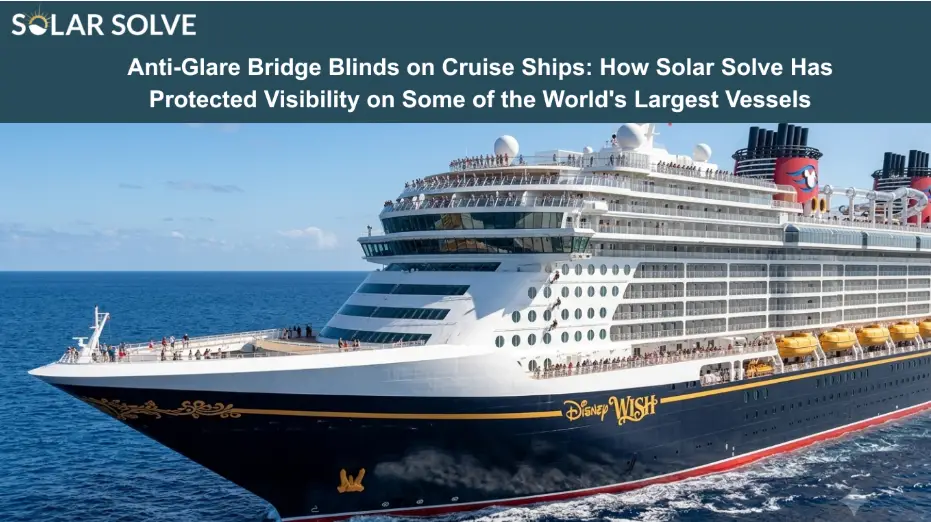
The Navigation Bridge of a Cruise Ship: A Unique Glare Challenge
A cruise ship navigation bridge is one of the most demanding solar environments in the maritime world. Large glazed bridge windows, designed to give officers of the watch a panoramic forward view, expose the bridge to solar conditions that vary dramatically across a single voyage. A vessel sailing from Southampton to the Caribbean passes through Northern European grey skies, Atlantic open-ocean conditions, tropical sun and the dazzling reflectivity of Caribbean coastal waters — all in the same round trip.
The bridge crew managing this vessel operates on long watches throughout the entire passage. They navigate busy English Channel traffic, open Atlantic swells, approach busy port environments in Barbados or St Lucia, and anchor in high-sun conditions where the glare bouncing off the water surface is intense and sustained. In all of these conditions, the crew’s ability to see clearly through the bridge windows — to read navigation markers, identify other vessels, monitor chart displays and assess sea conditions — is the foundation of safe ship handling.
Uncontrolled solar glare on a cruise ship bridge is not a comfort issue. It is a navigation safety issue. And it is one that Solar Solve has been solving for the world’s leading cruise operators for decades.
Why Cruise Ships Have Particular Solar Screen Requirements
Cruise ships present a specific set of solar screen requirements that differ from those of cargo vessels, ferries or naval ships in several important ways.
Scale of glazing. Modern cruise ships are built with extensive bridge glazing, often spanning the full width of the vessel and incorporating curved, angled and multi-panel window configurations. The solar screening solution must cover this glazing completely and consistently, maintaining uniform glare and heat control across every window in the bridge array.
Route diversity. Cruise ships operate across a wider range of latitudes and solar conditions than most commercial vessel types. A vessel running Caribbean and Alaska routes in the same season faces extreme contrasts in solar intensity. The solar screen must perform reliably across this full range — from arctic brightness on snowfields and glaciers to equatorial intensity in the Caribbean and Pacific.
Crew watch patterns. Officers on cruise ship bridges often work concentrated watches in heavily trafficked coastal and port environments where the demands on attention and visibility are highest. The accumulated effect of glare and heat across these watches directly affects crew alertness and decision quality at the moments that matter most — approaching ports, navigating channels and handling the vessel at anchor or berth.
Appearance standards. Cruise ships operate to high aesthetic standards both internally and externally. The anti-glare screens fitted to bridge windows must present cleanly and professionally from outside the vessel. The SOLASAFE® cassette design, available in over 400 aluminium profile colour options, meets this requirement directly — producing a finished, professional appearance that integrates with the bridge window architecture rather than sitting across it as a visible afterthought.
Passenger and operator reputation. Cruise operators manage brands that their passengers recognise and trust. Cunard, Holland America and Celebrity Cruises each represent decades of passenger loyalty and operational reputation. The equipment they specify for safety-critical bridge applications reflects that standard. Type Approved SOLASOLV® screens are the specification that meets it.
Cunard: SOLASOLV® on Queen Elizabeth
Cunard Line is one of the most recognisable names in passenger shipping. The line’s vessels operate on worldwide itineraries including transatlantic crossings, Caribbean voyages, world cruises and Alaskan passages — a route diversity that places demanding and varied solar conditions on the navigation bridge crew throughout every voyage.
SOLASOLV® anti-glare screens are installed and in active use at the navigation bridge windows of Cunard’s Queen Elizabeth. The vessel made her debut voyage in 2010 and operates a wide variety of itineraries including Alaskan passages through Glacier Bay National Park, where she is one of a limited number of cruise ships permitted to sail in the UNESCO-listed waters.
The installation on Queen Elizabeth confirms SOLASOLV® screens performing at the bridge of a large, modern cruise vessel on routes that range from Northern European conditions to open Pacific and Alaskan waters. The screens provide the bridge crew with up to 93% glare reduction, up to 87% heat rejection and at least 98% UV filtration while maintaining 100% clear, undistorted outward visibility — the full SOLASOLV® performance specification in active daily use on one of the world’s most recognised cruise ships.
Holland America Line: SOLASAFE® Bridge Blinds Fitted and Operational
Holland America Line is one of the premium cruise brands operating large ocean-going vessels on worldwide itineraries. SOLASAFE® cassette roller screens have been fitted to the navigation bridge windows of Holland America vessels, providing the bridge crew with Type Approved anti-glare and heat rejection performance across the full range of routes operated by the line.
Holland America vessels operate on itineraries ranging from Alaska to Antarctica, from the Caribbean to the Mediterranean and across the Pacific. The breadth of solar conditions encountered across these routes makes consistent, reliable solar screen performance a genuine operational requirement rather than a comfort preference. The SOLASAFE® cassette design provides the protected film storage and self-cleaning brush system that maintains consistent performance through demanding operating schedules without requiring frequent maintenance intervention from bridge crew.
Celebrity Cruises: Multiple Vessels, Multiple Orders
Celebrity Cruises, the premium brand within the Royal Caribbean Cruises group, represents one of the most sustained relationships between a major cruise operator and Solar Solve’s product range. Multiple vessels across the Celebrity fleet have been fitted with SOLASOLV® screens.
Celebrity Millennium received 20 SOLASOLV® screens for the navigation bridge windows as part of the vessel’s refit programme. Celebrity Millennium is 294 metres in length with a passenger occupancy of 2,138 and operates on itineraries including Alaska and Asia. Following the Millennium order, Solar Solve entered discussions to supply the sister vessel Celebrity Summit on the same specification.
Celebrity Constellation, a Millennium-class vessel built in France in 2002, received SOLASOLV® solar shades for its navigation bridge windows. The vessel operates a varied seasonal schedule including the Baltic Sea and Norwegian Fjords during summer months and the Caribbean and Black Sea across the rest of the season — a route programme that places the bridge crew in high-glare Arctic summer conditions as well as sustained tropical sun.
Celebrity Infinity received SOLASOLV® marine sun shades supplied through an Italian marine equipment company — one of Solar Solve’s European distribution partners.
Celebrity Flora, the Royal Caribbean Galapagos Islands expedition vessel delivered by Dutch shipyard De Hoop BV, was fitted with 17 Type Approved SOLASAFE® roller screens supplied through Solar Solve’s premier European distributor, Rotterdam-based BV TEMARO. The screens were installed at the navigation bridge windows as part of the complete bridge window package for this purpose-built expedition vessel.
The repeat orders across the Celebrity fleet reflect a pattern that Solar Solve sees consistently with cruise operators: a first order for one vessel, followed by orders for sister vessels and fleet-wide refit programmes as the performance of the screens in service confirms the specification decision.
TUI Cruises: Mein Schiff 2
TUI Cruises’ Mein Schiff 2 was among the vessels supplied with SOLASOLV® anti-glare solar screens, further demonstrating the breadth of cruise operators who specify Solar Solve products for their navigation bridge windows. Mein Schiff 2 is a large modern cruise vessel operating on European and worldwide itineraries under the TUI brand.
What Cruise Ship Bridge Crews Experience with SOLASOLV® Screens
The operational experience of cruise ship bridge crews using SOLASOLV® screens is consistent across the vessels and operators named above. The screens address the four primary solar problems on a cruise ship bridge:
Glare on electronic chart displays. ECDIS screens, radar displays and navigation computers that are washed out by direct sunlight become clearly readable once SOLASOLV® screens are deployed. Officers of the watch can read their instruments accurately throughout the watch without repositioning or shading displays manually.
Forward visibility in high-glare conditions. Navigation markers, other vessels, coastlines and hazards that are difficult to identify against a bright glare background become clearly visible through the screened windows. True colour rendition is maintained — markers appear in their correct colours.
Bridge temperature management. With up to 87% of solar heat rejected before it enters the bridge, the interior temperature is maintained at a level where the crew can concentrate effectively throughout long watches. Air conditioning systems work less hard. For larger cruise vessels on long voyages, this translates to measurable fuel savings on air conditioning power.
UV protection for crew on long voyages. Officers on cruise ship bridges spend substantial accumulated time at bridge windows across long voyages. At least 98% UV filtration protects crew members from the long-term skin and eye health consequences of sustained UV exposure through unscreened glass.
For full product specifications and to discuss requirements for cruise vessel bridge windows, visit the SOLASAFE product page or the marine solar screens page.
Why Cruise Operators Choose SOLASOLV®
The common thread across all of the cruise operators named above is specification confidence. Procurement managers and technical superintendents specifying anti-glare screens for cruise ship bridge windows need a product that:
Holds independent Type Approval from recognised classification societies — SOLASOLV® holds approval from Lloyd’s Register, DNV, ABS and RINA, the four leading societies worldwide.
Performs consistently across the full range of solar conditions encountered on cruise itineraries — from Arctic brightness in Alaska and Norway to sustained tropical intensity in the Caribbean and Pacific.
Maintains full outward visibility at all times — a non-negotiable requirement for any navigation bridge installation.
Is custom made to the exact dimensions and window profile of the vessel — every SOLASOLV® screen is manufactured to measure at Solar Solve’s UK facility in South Shields and dispatched to vessel locations worldwide, typically within three to five working days.
Comes with a seven-year guarantee — reflecting the manufacturing quality and material stability of the SOLASOLV® shade film in demanding marine environments.
Is backed by a manufacturer with a proven track record across more than 20,000 vessels in 108 countries since 1975.
For cruise vessel procurement teams, the combination of four Type Approvals, independently verified performance data, custom manufacturing capability and a 50-year track record in marine solar screen supply represents the lowest-risk specification decision available in the market.
For guidance on specifying SOLASOLV® screens for cruise vessel bridge windows, including film colour selection and window shape options, visit the Solar Solve technical information.
Frequently Asked Questions
Q: Are SOLASOLV® screens suitable for navigation bridge windows on large cruise ships
A: Yes. SOLASOLV® screens are custom made for each installation and have been supplied to large cruise vessels including Cunard’s Queen Elizabeth, Holland America vessels, Celebrity Millennium, Celebrity Constellation, Celebrity Infinity, Celebrity Flora and TUI’s Mein Schiff 2. Every screen is manufactured to the exact window dimensions and profile of the vessel.
Q: Are SOLASOLV® cruise ship screens Type Approved?
A: Yes. SOLASAFE® and SOLAROLA® screens hold Type Approval from Lloyd’s Register, DNV, ABS and RINA — the four leading marine classification societies. All Type Approved screens meet SOLAS and IMO standards for navigation bridge visibility.
Q: Do SOLASOLV® screens maintain the crew’s outward visibility on a cruise ship bridge?
A: Yes. SOLASOLV® screens maintain 100% clear, undistorted outward visibility with true colour rendition while reducing up to 93% of glare and up to 87% of solar heat. Navigation markers and sea conditions appear in their correct colours through the screen.
Q: Can SOLASOLV® screens be retrofitted to existing cruise ship bridges?
A: Yes. All SOLASOLV® screens are suitable for retrofit installation on existing vessels as well as new build specification. The Celebrity Millennium and Celebrity Constellation installations were both retrofit orders supplied to vessels in active service.
Q: How long does it take to manufacture and deliver custom screens for a cruise ship refit?
A: SOLASAFE® screens are normally manufactured and dispatched within three to five working days. Same-day dispatch is available for urgent orders, allowing screens to arrive at the vessel’s next port of call on time for the sailing schedule.
Q: Which SOLASOLV® film colour is recommended for cruise ships on tropical routes?
A: Silver film delivers the highest heat rejection across the SOLASOLV® range and is recommended for vessels on sustained high-intensity solar routes including the Caribbean, Pacific and equatorial passages. All four film colours — Gold, Silver, Grey and Bronze — deliver the same 93% glare reduction and 98% UV filtration performance.
Q: Does Solar Solve supply both bridge solar screens and cabin blinds for cruise ships?
A: Yes. Solar Solve supplies SOLASOLV® anti-glare solar screens for navigation bridge windows and ROLASOLV® fabric roller blinds for crew and passenger accommodation areas. The ROLASOLV® range includes Type Approved blackout blinds for daytime sleeping in crew cabins, providing complete solar management across the whole vessel.

